Misaligned Fan Blades Trigger Catastrophic Engine Failure in Thunderbird F-16 Crash
Posted By
Common Defense
On
In National Security, News |
No Comments
Misaligned fan blades caused the engine failure that brought down a Thunderbirds F-16 during a routine training flight in California late last year, according to a recently released Air Combat Command report.
The pilot ejected safely after losing thrust at low altitude.
The crash occurred Dec. 3, 2025, near Trona, California. The F-16CM Fighting Falcon was assigned to the Air Demonstration Squadron “Thunderbirds” at Nellis Air Force Base, Nevada.
The aircraft was destroyed on impact, resulting in the complete loss of the $33.4 million jet.
The pilot suffered only minor injuries, while no fatalities or damage to civilian property were reported.
During the training flight, the pilot experienced a loss of thrust while operating at low altitude.
The pilot initiated corrective action procedures but could not restore enough thrust to keep the aircraft flying, according to the report.
The planned mission called for the Thunderbirds to perform a vertical loop followed by a barrel roll.
Because of neck stiffness, the pilot was supposed to separate from the formation during the loops and rejoin it during the rolls.
The engine stalled as the pilot was returning to the formation. In the report, the pilot said “the jet just … stopped midair,” capturing the sudden and severe nature of the failure.
The pilot moved the engine control switch to its secondary control setting, which caused the engine to “flameout.”
Image Credit: DoW
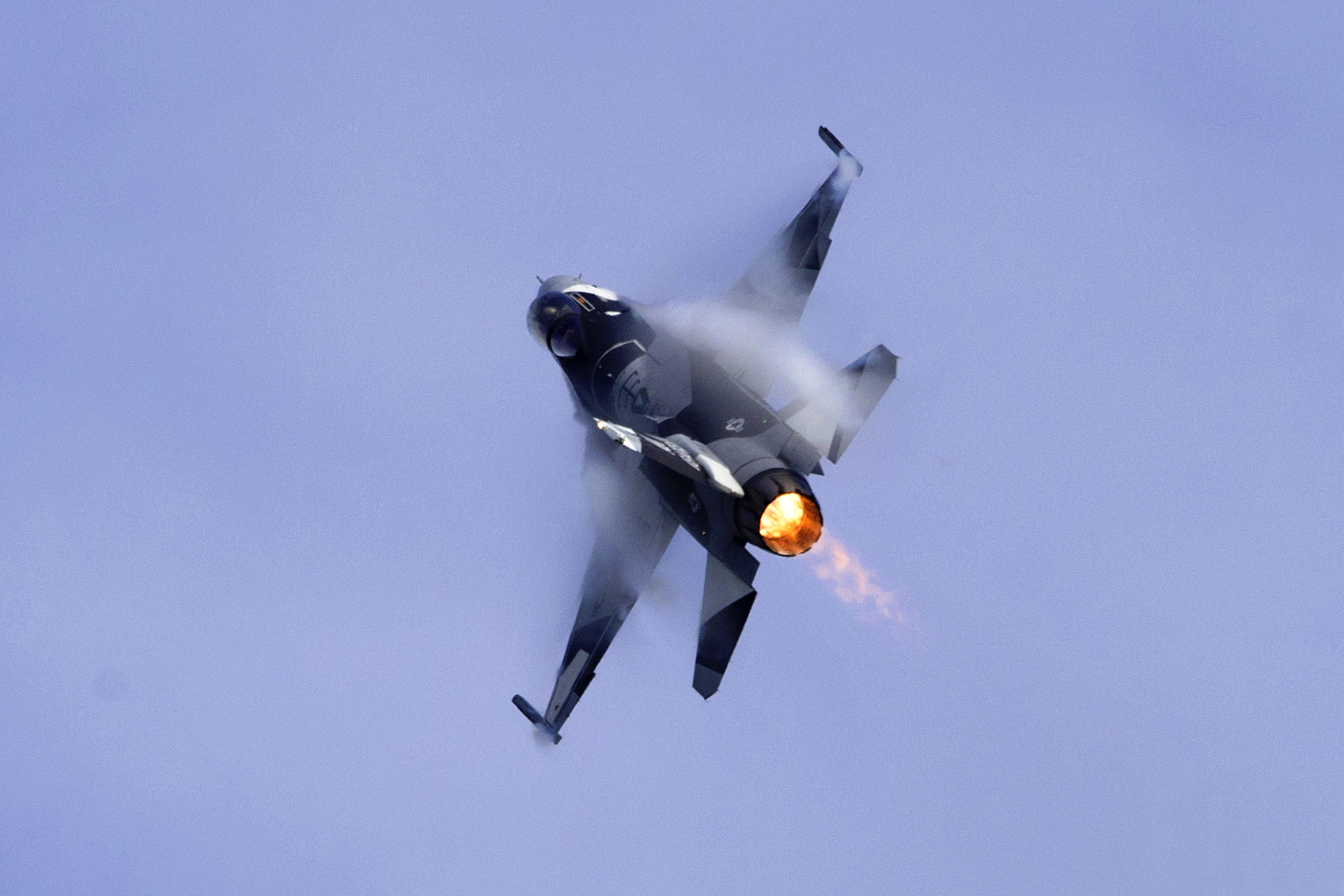
A U.S. Air Force F-16 Fighting Falcon, assigned to the 18th Aggressor Squadron out of Eilson Air Force Base, performs aerial maneuvers during the Arctic Thunder Open House at Joint Base Elmendorf-Richardson, Alaska, June 30, 2018. This biennial event hosted by JBER is one of the largest in the state and one of the premier aerial demonstrations in the world. The event features multiple performers and ground acts to include the JBER joint forces, U.S. Air Force F-22 and U.S. Air Force Thunderbirds demonstrations teams, June 30-July 1. (U.S. Air Force photo by Alejandro Peña)
The pilot later reported that “it sounded like things were grinding” inside the engine.
Approximately four minutes after the initial loss of thrust, the pilot ejected.
By that point, the crippled F-16 was tumbling toward the ground at a rate of approximately 1,200 feet per minute, according to investigators.
The investigation traced the mishap to three turned variable vanes, or blades, in the fourth and fifth stages of the Pratt & Whitney F100-PW-229 engine.
Their position disrupted airflow and increased “vibratory stresses” on compressor blades in the fifth and sixth stages.
One blade in the fifth stage and another in the sixth stage eventually failed because of fatigue.
Both blades fractured and separated during flight, inflicting “catastrophic” engine damage while the aircraft was at low altitude.
The damage left the pilot without the ability to sustain flight operations or recover the aircraft.
Image Credit: DoW
The U.S. Air Force Thunderbirds perform at the Great Colorado Air Show on Sept. 20, 2025, in Loveland, Colorado. (Staff Sgt. Breanna Klemm/U.S. Air Force)
Investigators later found blades missing from the fifth and sixth stages, but they could not determine what had caused the three variable vanes to turn because sufficient evidence was unavailable.
The F-16 had flown the day before the accident without discrepancies or maintenance reports.
However, the report explained that maintenance personnel cannot easily examine the fourth and fifth stage variable vanes or the fifth and sixth stages of the engine core.
Conducting those inspections requires crews to remove the engine from the aircraft and open the rear compressor case.
That limitation meant the affected internal areas were not readily available for routine visual inspection before the training flight.
The report also identified a documented foreign object damage event from October 2021, when the engine was installed in another aircraft.
That event damaged the third stage of the Inlet Fan Module and the turbine exhaust cone assembly, although technicians recorded no damage in the fourth, seventh or eighth stages.
Because no damage was observed in those areas, no additional inspection of the engine core was conducted.
After that event, damage was detected on three separate occasions in the first stage, and “foreign material” was recovered from the fourth stage.
Image Credit: DoW
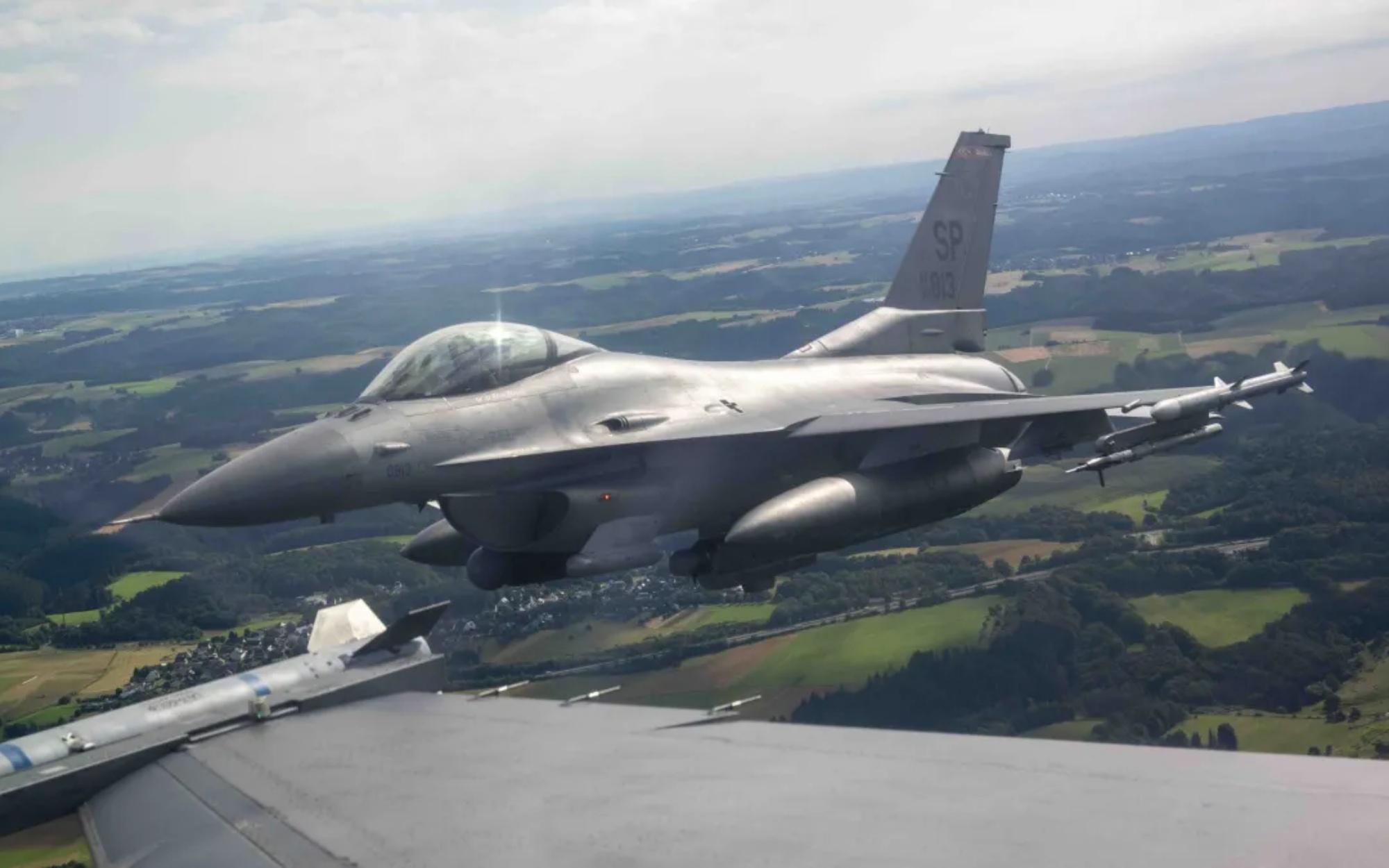
F-16s with the 480th Fighter Squadron fly over Germany in 2024. Air Force photo by Senior Airman Jessica Sanchez-Chen.
Investigators concluded that the earlier foreign object damage “substantially contributed” to the crash.
The fifth and sixth stages were not inspected after the 2021 event because technicians had not found damage in the preceding section of the engine.
The report described an inspection schedule that could allow internal damage to remain hidden until required maintenance. “Additionally,” the investigator writes, “the core of the engine is only inspected during scheduled maintenance when a core component reaches its overhaul threshold, leaving time for potential damage to progress undetected.”
The chain of internal failures ultimately left the pilot with no workable path to save the aircraft.
The ejection prevented a fatal outcome, but the Thunderbirds lost a $33.4 million F-16 after hidden engine damage progressed into a catastrophic failure.
![Thunderbirds Pilot Ejects Safely as F-16 Crashes During California Training Mission [WATCH]](https://www.commondef.com/wp-content/uploads/2025/12/2025.12.04-01.21-commondefense-69318ae1c89dc.jpg)