U.S. Army Races to Test Counter-Drone Arsenal as Cartel Incursions Surge
Posted By
Common Defense
On
In National Security, News |
No Comments
The U.S. Army is testing counter-drone technology near the border with Mexico as cartel drone activity increases. The effort is intended to improve defenses while drawing lessons from the rapid battlefield innovation seen during Ukraine’s war with Russia.
Soldiers observed demonstrations during Falcon Peak, a U.S. Northern Command exercise held in Arizona in September. Defense firms presented radars, interceptor drones, autonomous gun systems and other equipment built to detect, track and destroy small unmanned aircraft.
The event placed emerging counter-drone systems in an operational setting rather than a controlled laboratory environment. Officials said the border provides an opportunity to test equipment, train soldiers and assess how technologies perform under practical conditions.
Army officials described the drones crossing the southern border as mostly commercially available systems. Criminal organizations use them for surveillance connected to smuggling and human trafficking operations, according to the officials.
Brigadier General Brian Filler, deputy commander for operations at Joint Task Force Southern Border, told reporters that the military had detected 378 drone incursions during the previous 30 days. He also said the trend was increasing.
“We are seeing largely commercial off-the-shelf available drones,” Filler said. Most carry surveillance cameras and are frequently observed alongside movements across the border, he added.
Image Credit: DoW
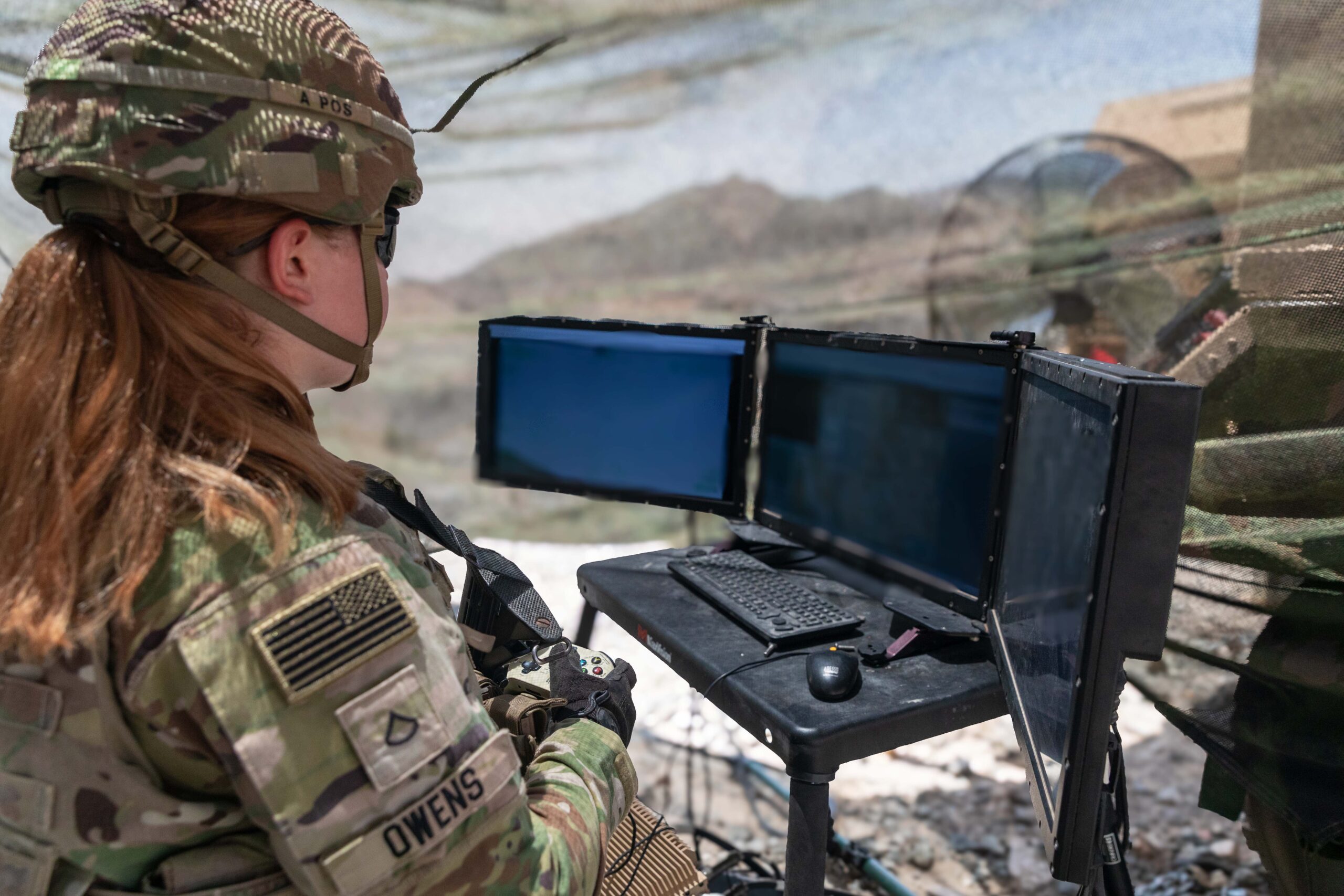
U.S Army Pfc. Janelle Owens, assigned to Alpha Battery, 2nd Battalion, 77th Field Artillery Regiment, under Joint Task Force-Southern Border, conducts screening operations using the Ground-Based Operational Surveillance System (GBOSS(E)), near Yuma, Ariz., July 7, 2025. The G-BOSS(E) is a mobile, self-contained surveillance system developed for persistent observation and threat detection. Joint Task Force-Southern Border executes full-scale, agile, and all-domain operations in support of U.S. Customs and Border Protection to protect the territorial integrity of the United States and achieve 100% operational control of the southern border. (U.S. Army photo by Sgt. Crist Joseph)
The military earlier this month said it had destroyed 11 cartel drones with lasers. The drones were downed after the technology was deployed along the southern border in August.
Military planners are working to keep pace with developments emerging from Ukraine, where drones have reshaped battlefield operations. Their widespread use has driven fast innovation in both systems designed to attack and technologies created to stop those attacks.
Officials cautioned that drones operated by cartels are not comparable with the more sophisticated battlefield systems used in Ukraine or the Middle East. Even so, the border gives troops and developers a setting where equipment can be evaluated beyond laboratory testing.
Falcon Peak also reflected the Pentagon’s increasing interest in defense technology companies backed by venture capital. Since Russia’s 2022 invasion of Ukraine, investors have directed billions of dollars toward companies pursuing military contracts for drone and counter-drone systems.
Image Credit: DoW
Those companies include Anduril, Shield AI and Saronic, along with numerous smaller startups working on related technology. The investment push has placed private firms at the center of efforts to produce and refine systems for evolving military requirements.
Anduril’s Ghost drone appeared in the demonstrations. The exercise also included a detection system using radar and cameras from Teledyne FLIR and the “Bullfrog” counter-drone automated machine gun produced by Allen Control Systems.
An interceptor drone sold by Powerus was also presented. Powerus went public on Thursday through a merger with a company backed by sons of U.S. President Donald Trump.
The collection of systems showed the range of approaches being considered against small unmanned aircraft. The demonstrations covered detection, tracking and interception, including options using drones, automated weapons and lasers.
Image Credit: Department of War
Officials said one objective is to reproduce the fast cycle of adjustment and improvement seen in Ukraine. That process has allowed battlefield users and technology developers to respond quickly as drone tactics and defensive measures change.
“We tend to look at Ukraine and we say, ‘I am so impressed with how quickly they can adapt on a daily or weekly basis,’” Brigadier General Matt Ross told reporters. His remarks focused on the speed with which new methods and systems are refined.
“What we should really do is replicate that process,” Ross said. Falcon Peak gave the Army and participating companies a place to demonstrate how that approach could be applied while responding to rising cartel drone incursions along the southern border.