France Turns Tank Gunners Into FPV Drone Hunters as Army Races to Scale Up
Posted By
Common Defense
On
In National Security, News |
No Comments
Corporal Igor traded the sights of a 105 mm gun for first person view goggles and a handheld controller this year. The 21 year old former AMX 10 RC gunner is now a strike pilot in France’s first dedicated drone combat squadron.
During a June exercise at Mailly-le-Camp east of Paris, Igor crouched among nettles and tall grass while guiding an FPV drone along a forest path. “We’re switching specialties, we’re keeping up with the times,” he said.
The 1st Marine Infantry Regiment, or 1er RIMa, converted one of its three light cavalry squadrons into an experimental drone unit after studying the war in Ukraine. The results persuaded the French Army to accelerate plans for more formations.
Army Chief of Staff Gen. Jacques de Montgros said France aims to field around 15 drone combat units by summer 2027. France recently deployed one such unit to Romania under Mission Aigle and plans to send another to Poland for an exercise.
The 1er RIMa’s squadron combines surveillance aircraft, FPV one way attack drones and loitering munitions. It also works with French companies on swarming, autonomous terminal guidance and launch canisters.
The concept began in late 2023 inside the regiment’s training and operations office. Capt. Guillaume, an open source intelligence specialist studying Ukraine, proposed going beyond merely adding drones to existing formations and instead building a mobile force around them.
Col. Aymeric Caussin said an experimental formation caused “a crazy amount of disruption” during a tactical exercise. The resulting squadron retained light cavalry principles centered on intelligence, mobility, dispersion, stealth and the ability to fix, outflank and destroy an opponent.
Its impact became clear during Exercise Hedgehog in Estonia in May 2025. About 10 French drone pilots joined a combined arms tactical group facing the U.S. 5th squadron, 7th Cavalry Regiment, which operated dismounted troops and M2A4 Bradley Fighting Vehicles.
The French pilots represented roughly 5% of their tactical group’s active strength but produced 20% of the attrition inflicted on the opposing American force during one day. Within two months, the drone squadron became official, and Army staff declared it operational in early April 2026.
The squadron continued scoring virtual kills during Orion 2026, where its pilots tallied four regimental command posts, logistics convoys, counter drone units and air defense elements. Its reconnaissance drones detected command posts several kilometers behind the front before directing artillery or FPV attacks.
Image Credit: DoW
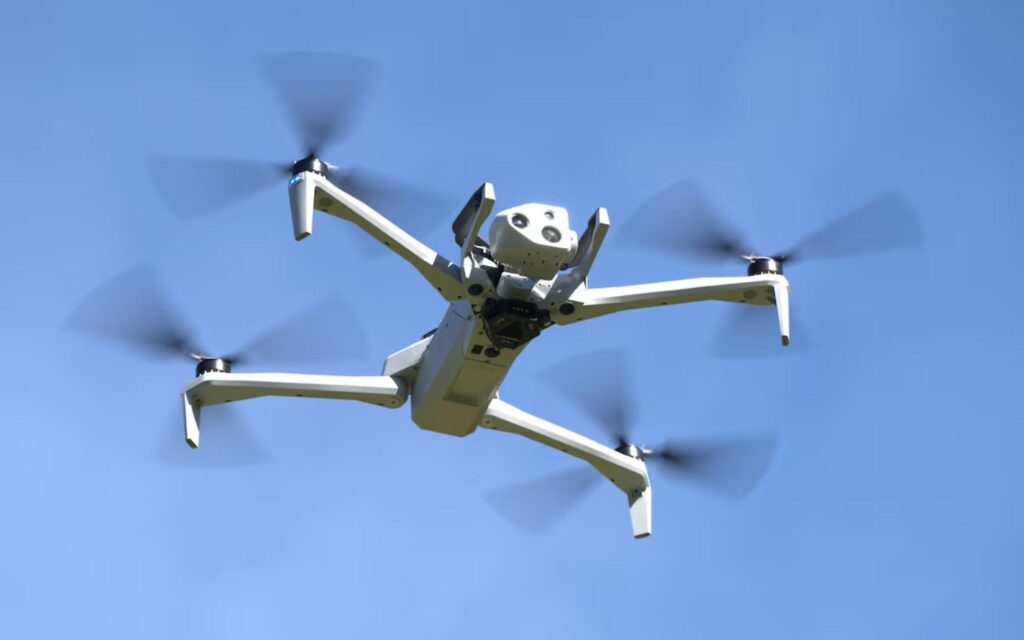
For the first time, the Air Force Office of Special Investigations has certified a group of special agents to operate and instruct others on the Skydio X10D ahead of fielding the drones in January 2027. (Cathleen Close/U.S. Air Force)
A March exercise at Mailly-le-Camp delivered another severe result, with drone pilots attacking armor, tracking vehicles to command posts and striking troop concentrations. Officers cautioned that the opposing regiment had inadequate counter drone capabilities and few drones of its own.
France now wants five more regiments equipped with complete drone squadrons. The 6th Armored Brigade, assigned to create two of them, decided to establish a third using its own resources, while preserving conventional skills among troops trained on Akeron antitank missiles and 81 millimeter mortars.
The brigade found that drones could achieve initial saturation but could not stop a numerically stronger enemy without troops holding the line. “We quickly get overwhelmed if we don’t also have men behind them with rifles or other weapons,” 6th Armored Brigade commander Gen. Maxime do Tran said.
A tougher June exercise introduced electronic warfare, greater dispersion, camouflage and vehicles held farther from the front. Electronic interference reduced drone effectiveness several times, allowing opposing armor to create temporary advantages and secure objectives.
Even under those conditions, the 1er RIMa squadron earned the best score among roughly 30 Army units that trained at Mailly-le-Camp over 12 months. The exercise reinforced the Army’s view that drones complement armored and infantry formations rather than replace them.
The squadron includes a command and logistics platoon, an intelligence, surveillance and reconnaissance platoon, two FPV platoons and a unit operating longer range loitering munitions. Around 100 of its 120 personnel are drone pilots, allowing the formation to cover an area normally assigned to a substantially larger force.
Its drone crews still carry Heckler & Koch rifles, a heavy machine gun and an AT4 shoulder fired antitank weapon. Logistics vehicles carry drones instead of ammunition, while battlefield power generation keeps batteries charged during operations in which a pilot may use 10 or 20 drones daily.
The regiment is also testing a concept called “queen and workers.” An operator controls a mother drone that directs multiple worker drones launched from canisters called hives, with the eventual goal of autonomous target identification and attack.
Current FPV hit rates may range from 5% to 10% for novice pilots and reach 30% for experienced operators. The AMX 10 RC cannon has a greater than 90% chance of landing a shot, but the regiment hopes autonomous terminal guidance can raise drone hit rates to between 80% and 90%.
The squadron seeks FPV strike ranges of 10 kilometers, while its reconnaissance platoon is beginning to reach the doctrinal goal of up to 20 kilometers. Communications remain the main practical obstacle, alongside weather, electronic jamming and counter drone systems.
Igor said the regiment must also prepare to face the same threat it now presents. “If we’re capable of doing it, we’re not the only ones who know how. So we’re going to try to find ways to protect ourselves from drones, because they’re really effective.”