Hochul and James Threaten New York Counties Over ICE Jail Agreements
Posted By
LifeZette Staff
On
In News |
No Comments
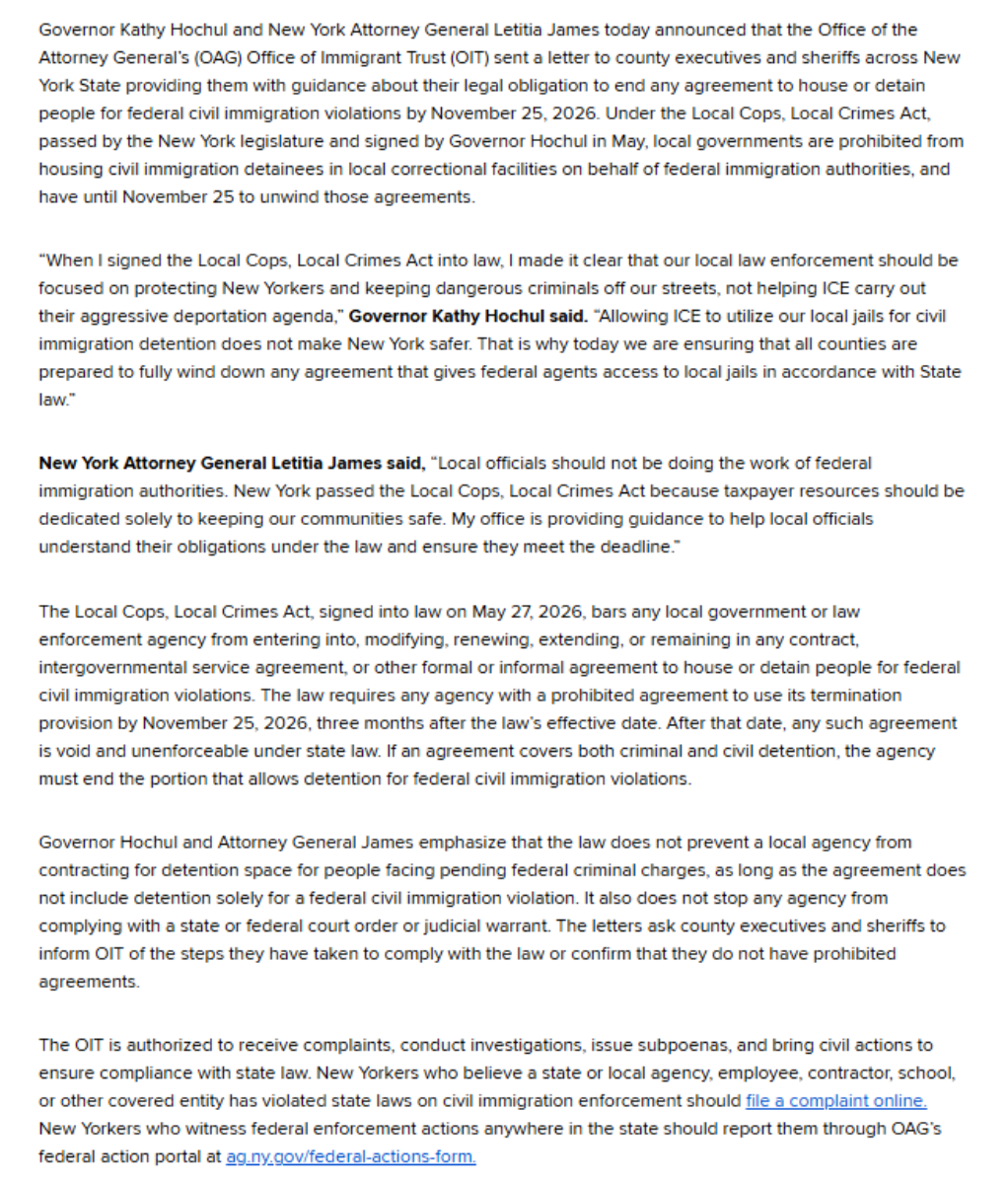
New York Governor Kathy Hochul and Attorney General Letitia James have delivered an ultimatum to county executives and sheriffs over agreements allowing ICE to use local jails. Counties have until November 25 to terminate covered arrangements or face possible state enforcement action.
The directive arrived[1] in a letter sent through the Attorney General’s Office of Immigrant Trust. State officials said the affected contracts will be void and unenforceable under New York law after the deadline.
County officials were instructed to use any available termination provisions to end the agreements. The order targets arrangements that permit local facilities to house or detain individuals for federal civil immigration violations.
Hochul presented the move as a question of law enforcement priorities. She said local law enforcement “should be focused on protecting New Yorkers and keeping dangerous criminals off our streets, not helping ICE carry out their aggressive deportation agenda.”
The governor also rejected the argument that local jail cooperation with ICE improves security. Hochul said that “allowing ICE to utilize our local jails for civil immigration detention does not make New York safer.”
The directive follows the Local Cops, Local Crimes Act, which Hochul signed on May 27. The law prohibits local governments and law enforcement agencies from entering into, modifying, renewing, extending, or remaining in covered detention agreements.
Local Cops, Local Crimes Act Prohibits Local Jails from Housing Civil Immigration Detainees Starting November 25
The ban applies to contracts and intergovernmental service agreements involving people held for federal civil immigration violations. It also reaches both formal and informal arrangements, including agreements authorized under sections of the Immigration and Nationality Act.
The law further restricts 287(g) agreements that deputize local officers to perform certain immigration functions. That provision places another barrier between local law enforcement agencies and federal immigration authorities.
Some counties have contracts covering both criminal detention and civil immigration detention. Under the state’s instructions, those counties must terminate only the portion of an agreement authorizing civil immigration holds.
The law retains exceptions in particular circumstances. Local authorities may continue detaining individuals who face pending federal criminal charges, and officials may comply with state or federal court orders or judicial warrants.
James’s office defended the crackdown by declaring that “local officials should not be doing the work of federal immigration authorities.” The office also said that “taxpayer resources should be dedicated solely to keeping our communities safe.”
The Attorney General’s Office of Immigrant Trust has several tools available to pursue compliance. It can receive complaints, conduct investigations, issue subpoenas, and bring civil actions against local entities that fail to follow the law.
The warning came after a federal judge denied a request from roughly 15 New York sheriffs seeking to halt the restrictions. The sheriffs were led by Rensselaer County Sheriff Kyle Bourgault and sought a preliminary injunction against the law.
The sheriffs argued that the state law interferes with their authority and existing agreements with the federal government. U.S. District Judge Mae A. D’Agostino denied that request on November 4.
D’Agostino ruled that the sheriffs had not demonstrated at this stage that they were likely to prevail on their constitutional claims against New York. The decision leaves the restrictions in effect while the broader lawsuit continues.
Hochul’s office celebrated the ruling as a victory for the state’s immigration policy. Her office said the decision preserves “critical protections” against what it described as ICE’s “aggressive and abusive enforcement tactics.”
For counties still operating under covered agreements, the state’s position leaves little ambiguity. They must terminate the civil immigration detention portions by November 25 while the sheriffs’ larger legal challenge proceeds in federal court.