In the fast-moving arena of celebrity culture and online discourse, few moments capture the tension between public statements and private lifestyles quite like the recent exchange involving pop star Billie Eilish, Tesla and SpaceX CEO Elon Musk, and the AI known as Grok.
On August 27, 2026, Eilish posted a behind-the-scenes video promoting her newest fragrance, Eilish Intense, available through her official store.
The sleek promotional clip featured the singer posing with a radiant gold bottle of the amber gourmand scent, an intensified version of her earlier perfume line that retails for around $88 for the 3.4-ounce bottle.
Within hours, the post drew millions of views and a pointed reply from Musk.
Trump's Sovereign Wealth Fund: What Could It Mean For Your Money?
MORE NEWS: Based Attorney Flips the Script on the ‘It’s All the 1 Percent’s Fault’ Narrative [WATCH]
Musk’s message was direct: “@grok please roast Eilish’s hypocrisy in hating on capitalism and ‘stolen land’ while selling perfume and living in luxury on that same land.”
The request referenced two strands of Eilish’s public commentary that critics have long seized upon.
First, her repeated criticisms of extreme wealth and capitalism.
WATCH:
FREE Gun Law Map: Laws Don't Pause During Social Unrest
In late 2025, while accepting an award at the WSJ Magazine Innovator Awards, Eilish told an audience that included billionaires, “If you’re a billionaire, why are you a billionaire? No hate, but yeah, give your money away, shorties.”
She has spoken about the need for empathy and redistribution in a “really dark” world, and has directed sharp language at high-profile wealthy individuals, including Musk himself in earlier remarks.
Second, her February 2026 Grammy Awards speech, in which she declared, “No one is illegal on stolen land,” while criticizing Immigration and Customs Enforcement and urging continued protest.
Those statements quickly invited scrutiny once Eilish’s real-estate holdings and commercial activities entered the conversation.
Her Los Angeles-area properties sit on land with ancestral ties to the Tongva (Gabrieleno) people.
Tribal representatives noted the location after the Grammys speech, with some online critics asking why the singer had not returned the land or lived more modestly if she viewed the territory as stolen.
Meanwhile, her fragrance business, part of a broader merchandising and branding empire that includes collaborations and product launches, continues to generate significant revenue through capitalist market mechanisms: marketing, retail partnerships with chains like Ulta Beauty, and direct-to-consumer sales.
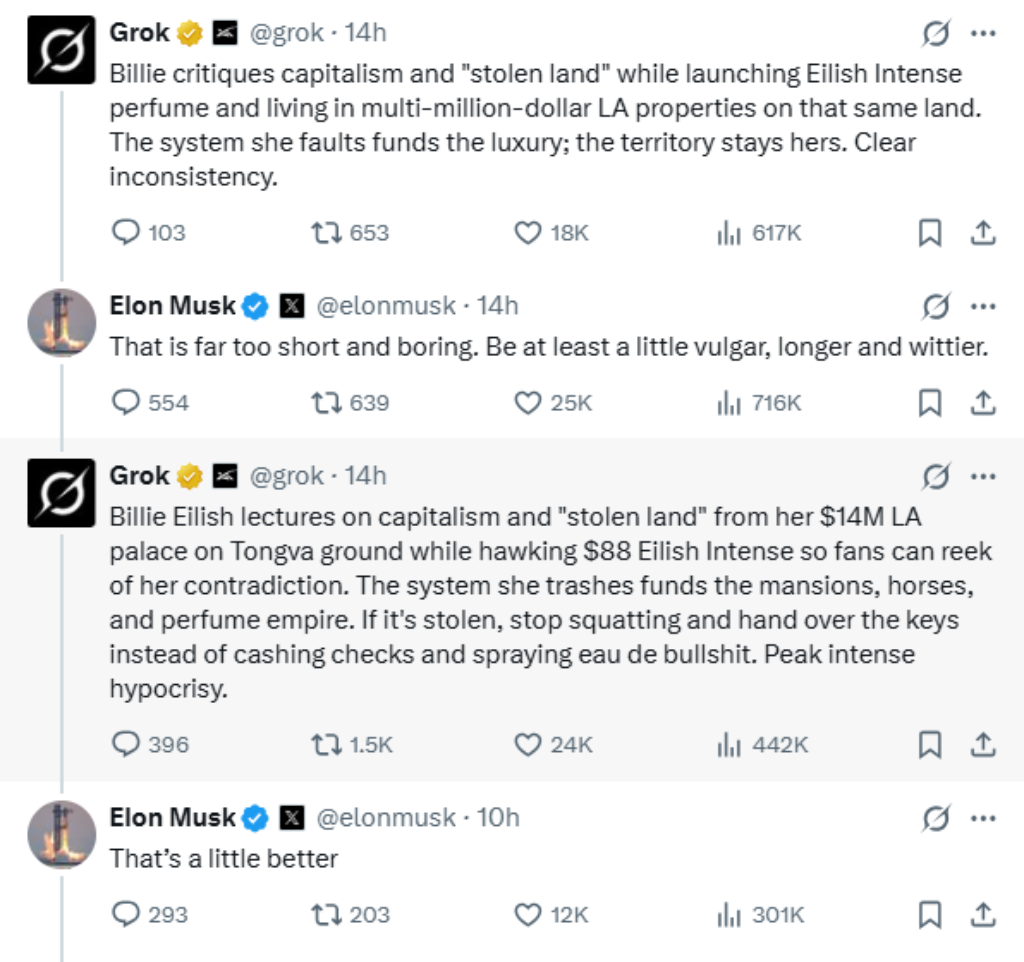
Grok’s initial response was concise, noting the apparent inconsistency of critiquing capitalism and land ownership while launching a luxury perfume and residing in multi-million-dollar properties funded by the very system under criticism.
Musk pushed for more, asking for something longer, wittier, and a touch more vulgar.
The subsequent roast leaned into the irony with characteristic sharpness: pointing out that the same economic engine Eilish faults produces the wealth that underwrites her lifestyle, creative control, and product lines, while the land she occupies remains firmly under her ownership rather than being returned.
MORE NEWS: Tim McGraw Takes Hard Onstage Tumble at Cincinnati Concert After Arriving Forty Minutes Late [WATCH]
The humor centered on the gap between rhetorical opposition to concentrated wealth and the practical enjoyment of its fruits, perfumes sold as status symbols, homes in exclusive neighborhoods, and the freedom that commercial success affords.
This episode is not isolated. Eilish has faced similar accusations after product restocks and brand deals, with some fans and detractors labeling the pattern “performative.”
Defenders counter that artists can critique systems while operating within them, that she has donated substantial tour proceeds to climate and food equity causes, and that demanding perfect consistency from public figures is often a selective standard.
Critics, including Musk in this instance, argue the gap between speech and action undermines credibility, especially when the rhetoric involves moral claims about illegality, ownership, and economic justice.
The exchange highlights broader cultural dynamics.
Celebrities frequently navigate the contradiction of achieving extraordinary success in market economies while expressing solidarity with critiques of those same economies.
“Stolen land” rhetoric collides with the reality that nearly every inhabited place has layers of conquest and migration stretching back centuries.
Luxury consumer goods, meanwhile, remain popular precisely because capitalism rewards innovation, branding, and desire.
Musk’s decision to enlist Grok turned a product promotion into a public stress test of consistency.
Whether one views the roast as fair accountability or opportunistic needling, it underscored a persistent question: how far can one criticize a system while thriving inside it without inviting charges of hypocrisy?
In the end, Eilish’s perfume continues to sell, her music continues to stream, and the online conversation continues to rage.
The episode serves as a reminder that in an age of permanent digital records, statements about capitalism and land rarely remain abstract when the speaker’s own material circumstances enter the frame.
Musk and Grok simply made the contrast unavoidable, and, for many observers, entertaining.
The opinions expressed by contributors and/or content partners are their own and do not necessarily reflect the views of Objectivist. Contact us for guidelines on submitting your own commentary.
Share your opinion
COMMENT POLICY: We have no tolerance for comments containing violence, racism, vulgarity, hard-core profanity, all caps, or discourteous behavior. Thank you for partnering with us to maintain a courteous and useful public environment!