WHAT YOU NEED TO KNOW
- A new U.S. Army poster helps soldiers identify personnel from Iran’s regular military, known as Artesh.
- The guide depicts Iranian uniforms, rank insignia, weapons and field equipment, including the AKM, Masaf-2, MG3 and RPG-7.
- Artesh is a mainly conscript force of 350,000 personnel covering armored, infantry, special forces, air defense, aircraft and naval units.
- The poster focuses on Artesh rather than the politically favored Islamic Revolutionary Guard Corps.
If the United States enters a ground war with Iran, the U.S. Army wants American soldiers to recognize the forces they could encounter. A newly released Army poster offers a detailed visual guide to a soldier from the Iranian army.
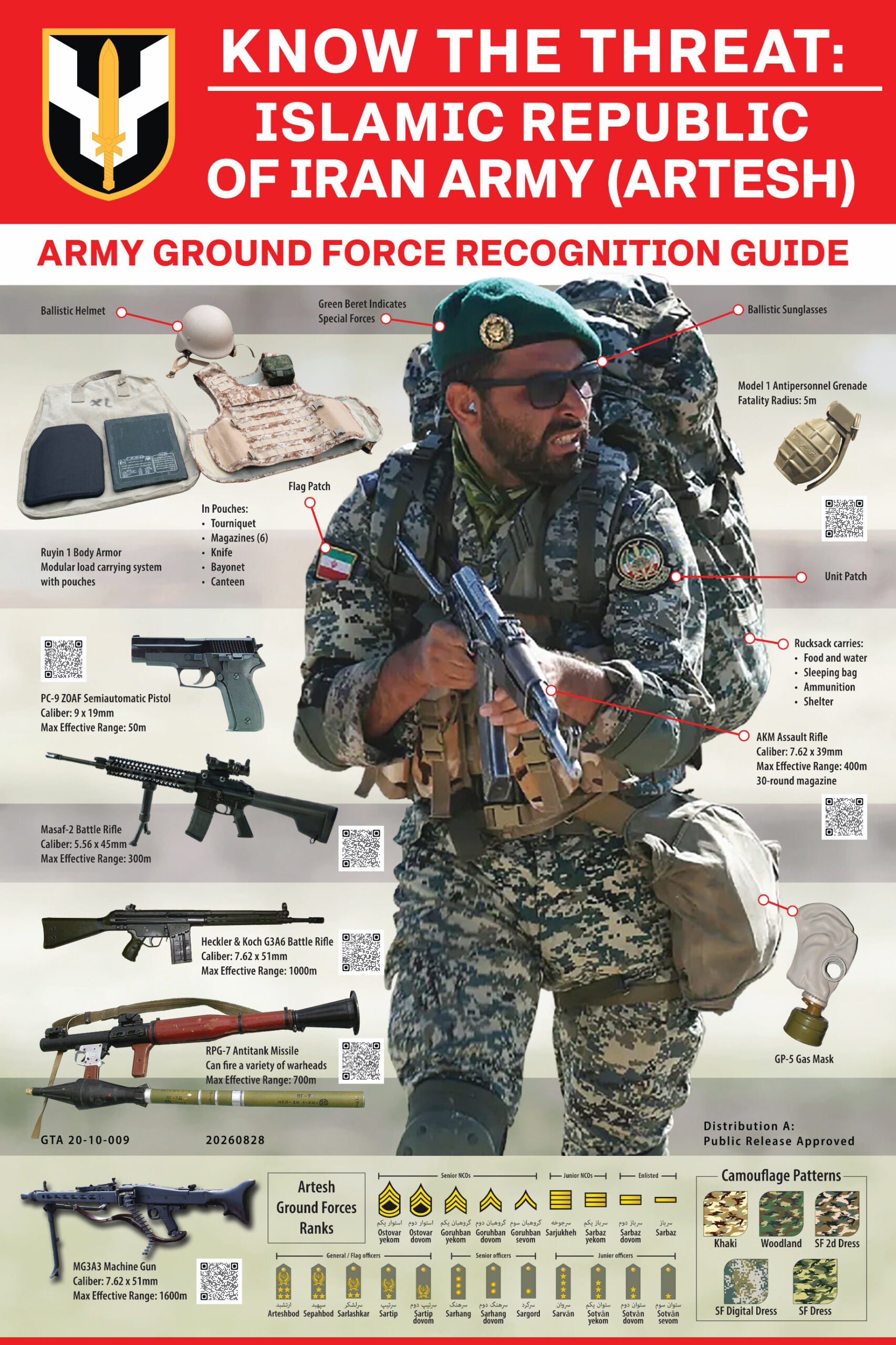
The graphic shows a bearded soldier wearing sunglasses and a beret. Captions identify the weapons he might carry, the equipment he could use and the different uniforms that Iranian troops may wear.
The existence of the guide does not mean the United States plans to invade Iran. The Army’s Training and Transformation Command maintains a library of graphical recognition posters covering the military forces of several nations, including China’s People’s Liberation Army.
Still, the poster arrives amid an ongoing conflict between the United States and Iran that has lasted nearly eight months. The fighting has remained centered on aircraft, missiles and drones, but the possibility of American troops operating on the ground has remained present.
Trump's Sovereign Wealth Fund: What Could It Mean For Your Money?
One potential ground mission described in the source would involve seizing vital Iranian oil facilities on Kharg Island. The guide, published Sept. 24, gives soldiers a closer look at personnel they could face if such ground operations ever occurred.
The poster is not focused on the Islamic Revolutionary Guard Corps, the Iranian regime’s praetorian guard and the organization that attracts most of the headlines. The IRGC controls many weapons fired at American forces and Iran’s neighbors.
Those weapons include ballistic missiles, drones and fast attack boats. Instead of highlighting the IRGC, however, the Army guide depicts a member of the Islamic Republic of Iran Army, which is also known as Artesh.
FREE Gun Law Map: Laws Don't Pause During Social Unrest
Artesh is a mainly conscript force with 350,000 personnel, according to the Institute for the Study of War. It serves as Iran’s regular armed forces and includes armored, infantry, special forces, air defense, aircraft and naval units.
The IRGC, by contrast, protects an Iranian regime that does not fully trust the regular armed forces, whose origins extend to the era of the Shah. The source compares that deliberate rivalry to arrangements in other authoritarian nations, including Saddam Hussein’s Iraq.
Under that kind of structure, the regular military competes with a more politicized armed force favored by the regime. The regime’s preferred force receives the best equipment, leaving the conventional military in a distinctly less privileged position.
Reports have described low morale and harsh conditions among Artesh personnel, including shortages of food and medical care. One Iranian draftee wrote in a 2022 Atlantic Council essay that most soldiers performed menial work instead of receiving combat training.
The soldier pictured in the Army poster wears the green beret associated with Iranian special forces. His appearance is not radically different from infantry personnel in many other militaries, and his equipment reflects a mixture of Soviet, Western and Iranian gear.
The weapons displayed include the AKM, Masaf-2 and Heckler & Koch G3A6 rifles. The soldier may also carry an MG3 machine gun or RPG-7, along with grenades, body armor, a rucksack, a canteen and a gas mask.
The guide shows five camouflage uniforms, including khaki and woodland patterns. It also presents three camouflage patterns used by Iranian special forces and provides insignia for both officer and enlisted ranks.
Taken together, the poster concentrates on the ordinary visual details soldiers would need to distinguish Artesh personnel, from weapons and rank insignia to uniforms and field equipment. It provides a focused look at Iran’s regular military rather than the politically favored IRGC forces that dominate public attention.
The opinions expressed by contributors and/or content partners are their own and do not necessarily reflect the views of Objectivist. Contact us for guidelines on submitting your own commentary.
Share your opinion
COMMENT POLICY: We have no tolerance for comments containing violence, racism, vulgarity, hard-core profanity, all caps, or discourteous behavior. Thank you for partnering with us to maintain a courteous and useful public environment!